Langsung ke konten utama

Seafood


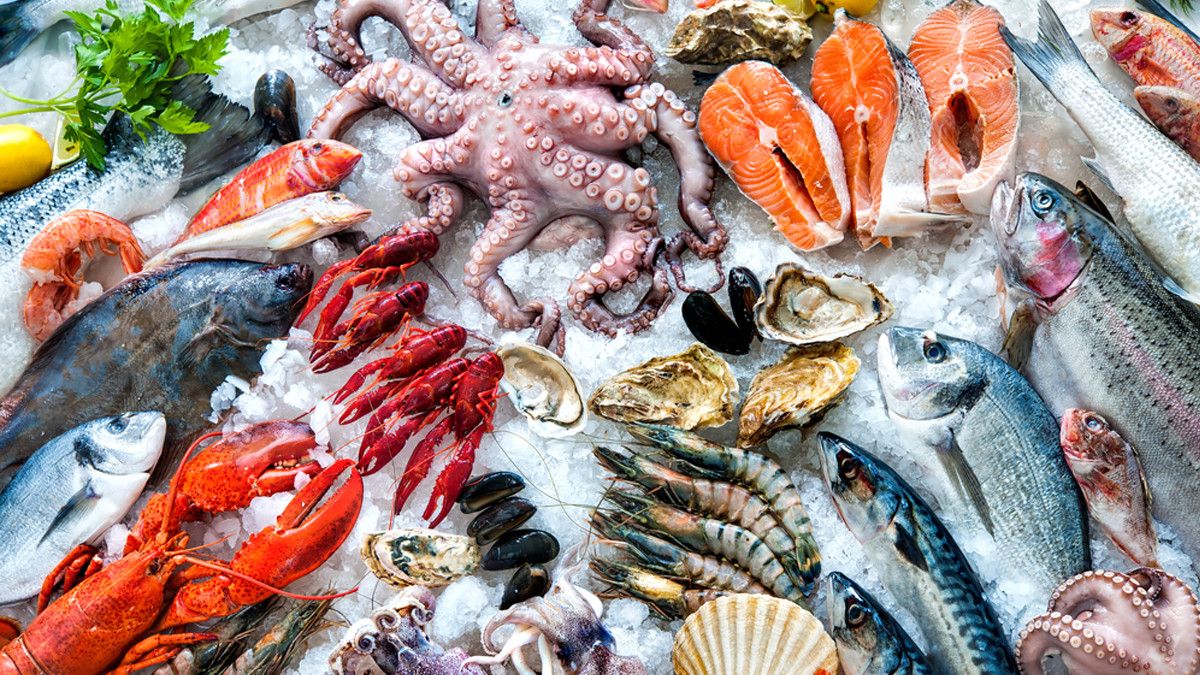
Seafood is any form of sea life regarded as food by humans, prominently including fish and shellfish. Shellfish include various species of molluscs (e.g. bivalve molluscs such as clams, oysters and mussels, and cephalopods such as octopus and squid), crustaceans (e.g. shrimp, crabs, and lobster), and echinoderms (e.g. sea cucumbers and sea urchins). Historically, marine mammals such as cetaceans (whales and dolphins) as well as seals have been eaten as food, though that happens to a lesser extent in modern times. Edible sea plants such as some seaweeds and microalgae are widely eaten as sea vegetables around the world, especially in Asia. In the United States, although not generally in the United Kingdom, the term "seafood" is extended to fresh water organisms eaten by humans, so all edible aquatic life may be referred to as "seafood".

Seafood is an important source of (animal) protein in many diets around the world, especially in coastal areas. Semi-vegetarians who consume seafood as the only source of meat are said to adhere to pescetarianism.

The harvesting of wild seafood is usually known as fishing or hunting, while the cultivation and farming of seafood is known as aquaculture and fish farming (in the case of fish). Most of the seafood harvest is consumed by humans, but a significant proportion is used as fish food to farm other fish or rear farm animals. Some seafoods (i.e. kelp) are used as food for other plants (a fertilizer). In these ways, seafoods are used to produce further food for human consumption. Also, products such as fish oil and spirulina tablets are extracted from seafoods. Some seafood is fed to aquarium fish, or used to feed domestic pets such as cats. A small proportion is used in medicine, or is used industrially for nonfood purposes (e.g. leather).


Seafood - Wikipedia

Komentar

Postingan populer dari blog ini

EDUCATION

\  Education is the process of facilitating learning, or the acquisition of knowledge, skills, values, morals, beliefs, habits, and personal development. Education originated as the transmission of cultural heritage from one generation to the next. Today, educational goals increasingly encompass new ideas such as the liberation of learners, critical thinking about presented information, skills needed for the modern society, empathy, and complex vocational skills. UNESCO defines three main learning settings. Formal education takes place in education and training institutions, is usually structured by curricular aims and objectives, and learning is typically guided by a teacher. In most regions, formal education is compulsory up to a certain age and commonly divided into educational stages such as kindergarten, primary school, and secondary school. Nonformal learning occurs as an addition or alternative to formal education.  It may be structured according to educational arrange...

National Monument

  The National Monument (Indonesian: Monumen Nasional, abbreviated Monas) is a 132 m (433 ft) obelisk in the centre of Merdeka Square, Central Jakarta, symbolizing the fight for Indonesia. It is the national monument of the Republic of Indonesia, built to commemorate the struggle for Indonesian independence. Construction began in 1961 under the direction of President Sukarno. Monas was opened to the public in 1975. It is topped by a flame covered with gold foil. The monument and the museum are open daily from 08.00 until 16.00 Western Indonesia Time (UTC+7) throughout the week except for the Mondays when the monument is closed. Since April 2016, the monument also opens during night time, from 19.00 until 22.00 on Tuesday to Friday, and from 19.00 until 00.00 on Saturday and Sunday. After the Indonesian government returned to Jakarta from Yogyakarta in 1950 following the Dutch recognition of Indonesian independence, President Sukarno began to contemplate the construction of a natio...

Blended Learning

Blended learning , also known as hybrid learning, is an approach to education that combines online educational materials and opportunities for interaction online with traditional place-based classroom methods. It requires the physical presence of both teacher and student, with some elements of student control over time, place, path, or pace.While students still attend "brick-and-mortar" schools with a teacher present, face-to-face classroom practices are combined with computer-mediated activities regarding content and delivery.Blended learning is also used in professional development and training settings. Since blended learning is highly context-dependent, a universal conception of it is difficult. Some reports have claimed that a lack of consensus on a hard definition of blended learning has led to difficulties in research on its effectiveness. A well-cited 2013 study broadly defined blended learning as a mixture of online and in-person delivery where the online portion eff...